


605+ Cannabis Strains over 20 Breeders worldwide.

Toll Free: +1 (800) 805-7835

Nutrients You Need for Healthy Cannabis Growth!

Cannabis has prospered and thrived in nature, untreated by human hands, since 2800 BC when its first documented cultivation cases can be traced back to Western China. In the intervening years, since the popularization of cannabis on a widespread scale, cultivation has become both familiar and common with home growers popping up worldwide.

The current cannabis revolution has led many growers to try their hands at crafting beautiful plants from the comfort of home. For individuals looking to enjoy healthy cannabis growth at home, they’ll need to pay close attention to the proper nutritional needs of their plants.

Today, we are going to take a close look at the most important nutrients for proper, healthy, and expedient cannabis cultivation.

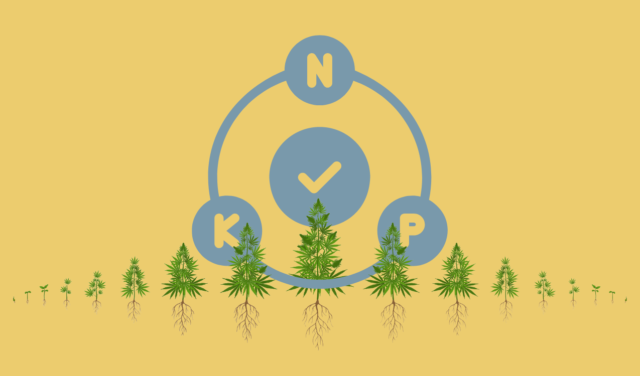
Plant Health and You: Understanding Your NPK.

When it comes to the cultivation of cannabis, the plant thrives best when its nutritional needs are met at every level. Many different elements can come into the equation when cultivating a plant, but for our purposes, we are going to be focusing on the primary nutrients and compounds that will make your plant thrive.

Aside from water and sunlight, you’ll want to make sure that you are properly supplying your plant with the following nutrients. These nutrients can be mixed into a water-soluble mixture, they can be added to your soil, or they can be added directly to the reservoir of a hydroponic-based cultivation system.

Nitrogen

One of the leading nutrients in successful cannabis cultivation is that of nitrogen. Nitrogen is crucial to cannabis growth because it directly impacts the production of chlorophyll and the process of photosynthesis, two incredibly important actions for the health and vitality of your plant.

The body of your plant itself is made up of nitrogen, so this will be one of the easiest nutrient deficiencies to identify should it become an issue. Regularly amending your soil or water-based growing system with nitrogen can help your plant to both feed and grow itself.

Signs of Deficiency

  • Mature leaves begin to brighten in color, turning yellow.
  • Yellowing throughout the plant coupled with brown spots on leaves.
  • Leaves begin to curl and fall from the plant.

Pro Tip: Growers can find natural sources of nitrogen by opting for supplements like bat guano, worm castings, and even fish meal.

Phosphorus

Found within every living plant cell, phosphorus is incredibly vital to the growth of your cannabis and the functionality of its biological response systems. Phosphorus is essential to photosynthesis, nutritional uptake, and a healthy metabolism.

Despite the importance of phosphorus to your plant’s health and vitality, this nutrient isn’t always so readily available. Phosphorus is mined and acquired through phosphate mines limited to just a few countries in the world. With increasing demand and decreasing yield, phosphorus can be difficult to acquire in some instances.

Signs of Deficiency

  • Darkened leaf colors.
  • Slower than normal growth rates.
  • In extreme instances, a lack of phosphorus can put a halt to upward and outward plant growth.
  • Leaves can end up a darkened bronze color.

Pro Tip: Growers can acquire natural phosphorus through bone meal, high phosphorus bat guano, and fish bone meal.

Potassium

Potassium is the third important macronutrient that we wanted to underscore today, right alongside Nitrogen and Phosphorus for the formulation of your NPK. Potassium is limited within the plant tissue but it does interact with proteins and amino acids, particularly during times of stress and even drought.

Potassium works by improving the structure and strength of the root system while increasing the density and volume of your plant’s buds. With proper levels of potassium during the flowering stage, growers can enjoy a large and vibrant yield.

Signs of Deficiency

  • Dark green leaves with brown and rusty tips.
  • Leaf burn is caused by dehydration and the curling of young leaves.
  • Weakened plants become more at risk of pests and disease.
  • The bottom layer of leaves could be dying.

Pro Tip: Growers looking to supply their plants with additional potassium can do so by amending their systems with greensand, wood ash, sulfate of potash, or compost.

Calcium

Considered one of the essential macronutrients for the cannabis plant, calcium is required for every phase of growth as it aids nutritional processing, allowing other nutrients to become absorbed easily. Calcium will additionally strengthen the cell walls of the plant while benefiting its overall health, allowing the plant to bounce back from potential diseases, pests, and stresses.

Signs of Deficiency

  • Slow plant growth.
  • Flowering production slows down.
  • Root tips begin to wither and die.
  • Necrotic blotches on leaves become a dark green color.

Pro Tip: While it is easy to find calcium in your soil, you can amend your hydroponic grow set-ups with eggshells, gypsum, and lime to improve your calcium levels.

Magnesium

The second most important macronutrient we will highlight today is magnesium. Magnesium directly impacts the leaves and the ability of your plant to absorb light. If your cannabis plant cannot properly absorb light while creating sugars and carbohydrates, the plant itself will begin to fail.

Signs of Deficiency

  • Only notable after 3 to 6 weeks.
  • Yellow leaves feature brown rust spots.
  • Diminished harvest after a slowed flowering period.
  • Plants will look sick and leaves will begin to curl up before dying and falling.

Pro Tip: You can amend your soil or hydroponic growing systems with dolomite lime and Epsom salt to improve the levels of magnesium in your soil.
 

When to Feed Your Cannabis Plants Nutrients!

You want to give your cannabis plants everything that they need to thrive, but it can be tough to figure out the right schedule for feeding your plants nutrients. Here, we’ll take a look at everything you need to know about giving your plants the exact nutrients they need to grow and thrive. 

What Do Cannabis Plants Need?

We all know the basics of what plants need to grow–light, carbon dioxide, and water–but plants sometimes also need a supplement of nutrients in addition to what their roots are able to pull from the soil. 

When growing cannabis, you’ll need to consider the specific needs of your plants to decide what nutrients are necessary for optimal growth. You’ll also need to consider the size of your plants, as well as their age. 

Choosing Your Soil

Starting with the right soil is a smart way to help your cannabis plants get off to a healthy start. Research the type of soil that’s best for your cannabis plant strain, but don’t be surprised if you find that you need to make some changes along the way. 

If you decide that you need to switch your plants over to a new soil, it’s smart to wait until it’s time to transplant. This can help your plant adjust, as the old soil will still be attached to the roots, allowing the roots to ease into their new home. 

If your plants are struggling with drainage and you want to add some new components to the soil, you may want to think about adding perlite (so that it makes up about 30% of the soil) and vermiculite (so that it makes up about 10% of the soil), as these can help improve drainage and help your plants get the oxygen that they need to grow. 

Learn About Your TDS

Your TDS stands for total dissolved solids, and as you begin to research how to feed your cannabis plants, you’ll likely come across this term often. Your TDS can give you an idea of how many nutrients and minerals are in your watering solution, but won’t tell you the actual makeup of the nutrients. While TDS can be a helpful number to help you see whether you’re headed in the right direction, you won’t want to rely on TDS alone to give you an idea of whether your plants are getting all that they need. 

The Ideal Feeding Schedule for Cannabis Plants

While following a feeding schedule for your cannabis plants is smart, you’ll also need to keep an eye on them to determine whether your schedule needs adjustment. It can take some time to get to know your plants and figure out exactly what they need to thrive. 

Weeks One and Two

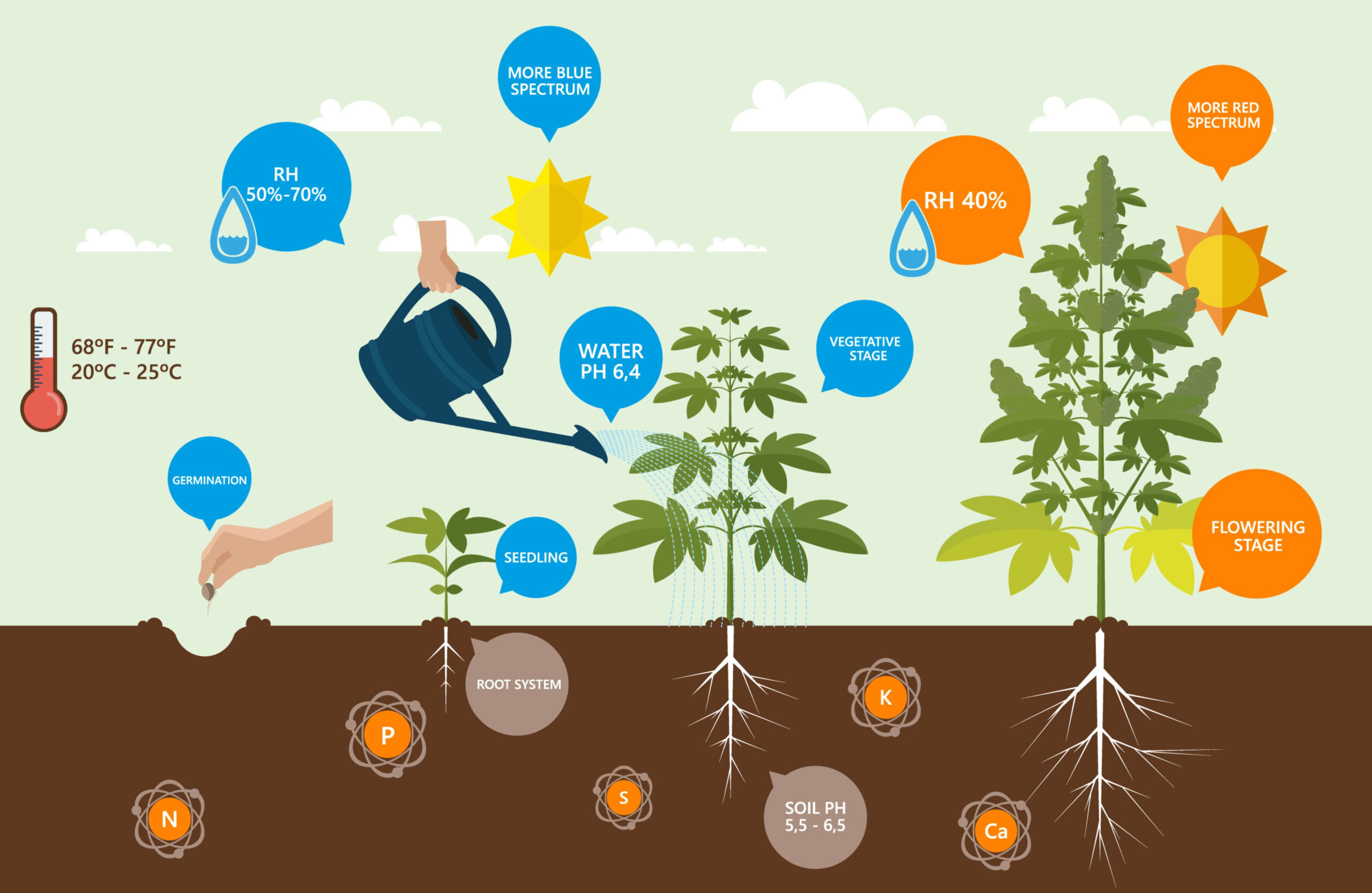
When you’re ready to transplant your seedlings into a larger home, that means you’ve entered the vegetative stage. During this stage of growth, it’s smart to use store-bought soil to ensure that your plants are getting off to the right start. 

You’ll want to choose soil that has solid water drainage and retention properties, and you’ll also want to keep an eye on the pH level of the soil you choose. You’ll want to shoot to maintain a pH of 6.0 to 6.5 for optimal growth. 

Instead of choosing a soil mix that’s heavily fertilized, you’ll want to manually add nutrients so that you stay in control of giving your plants what they need. In this stage, you’ll want to focus on giving your seedlings the light they need to begin to grow. 

During weeks one and two, keep your plants about three and a half feet away from your grow lamps. You’ll also want to only use half of your lamps during this phase, while still giving your plants about 18 hours of light per day. During the second week of the vegetative phase, it will be time to use a fertilizer high in nitrogen to ensure that your plants are getting enough of the crucial growth nutrient. 

Weeks Three and Four

During the third week of growth, your plants will begin to enter the flowering stage. At the start of week three, it will be time to change your light schedule to 12 hours on, 12 hours off, while using half of the lights. You’ll want to move your plants a bit closer to the lights, about a foot and a half away. Your plants are still heavily in the growing phase at this point, so you’ll want to continue to provide them with the nutrient mix that helped them get through weeks one and two. 

You’ll also want to begin giving your plants more water during this phase. Keep the humidity in the room around 60%. During week four, you’ll notice that your plants go through a major growth spurt, and you’ll want to ensure that they stay at least a foot and a half away from your grow lights, even as they begin to expand. 

When week four comes to an end, you’ll want to rinse the soil with water at a pH of 6.5. 

Weeks Five and Six

As you move into the fifth week of growth, you’ll begin to see flower development. At this point, you’ll need to make the switch to a high-phosphorus fertilizer to support growth. In the sixth week of growth, your’ll continue with the high-phosphorus fertilizer, and you’ll also want to ensure that you keep an eye out for any bugs on your plants. 

Weeks Seven and Eight

During this phase, you’ll notice that buds begin to grow. You’ll want to flush your soil with water (with a pH of 6.5) at the end of week seven. At the end of week eight, it’s smart to boost the potassium levels of your soil by using a fortified fertilizer. Adding more potassium will help your plant’s buds begin to ripen. 

At this point, in addition to keeping an eye out for bugs, you’ll also need to watch for mold. 

Weeks Nine and Ten

At this point, you’re getting ready to harvest, and you’ll need to switch up how you’re feeding your plants in order to make sure they’re ready. At the start of week nine, flush the soil, and then feed your plants their nutrient mix at a lower concentration than normal. You may find that the leaves on your plant are starting to die, but fear not–this is normal and to be expected. A few days prior to harvest, stop fertilizer altogether, and just provide your plants with clean water. 

Remember, keep an eye on your plants to learn what they need, and depend on their cues more than a schedule to figure out how to keep them growing healthy and strong. 


What Is the SOG Growing Method?

Cannabis has never been more popular or broadly accepted in mainstream society than it is today. The rise of home cultivation techniques, largely spurred on by the hydroponic growing movement of the ’80s, would normalize the cultivation of marijuana under the guidance of home growers. With marijuana now legal in a broad swathe of North America, for both medicinal and recreational use, more people than ever are interested in growing their cannabis.

One of the most popular marijuana growing techniques is the Sea of Green (“SOG”) method. A simple technique that focuses on cultivating many smaller plants within a limited space, the Sea of Green growing technique offers a mix of function and convenience.

Let’s explore the Sea of Green growing technique to better understand its advantages, processes, and potential outcomes.

What is the “Sea of Green” Growing Technique?

Often abbreviated “SOG”, the Sea of Green growing method forces cannabis to flower at a relatively young age. The ultimate goal of this low-stress growing technique is to induce a large number of small plants to flower within a relatively limited space, offering a sea of green in your grow room. This technique revolves around cannabis plants remaining in the vegetative state for just two weeks, bringing about a much earlier harvest. 

Once perfected, growers can utilize the Sea of Green growing method to bring about a harvest every 45 days, thus making it ideal for commercial and home growers alike.

Note – The Sea of Green growing method can be utilized with soil, hydroponics, and in both indoor and outdoor environments.

How Does the SOG Growing Method Work?

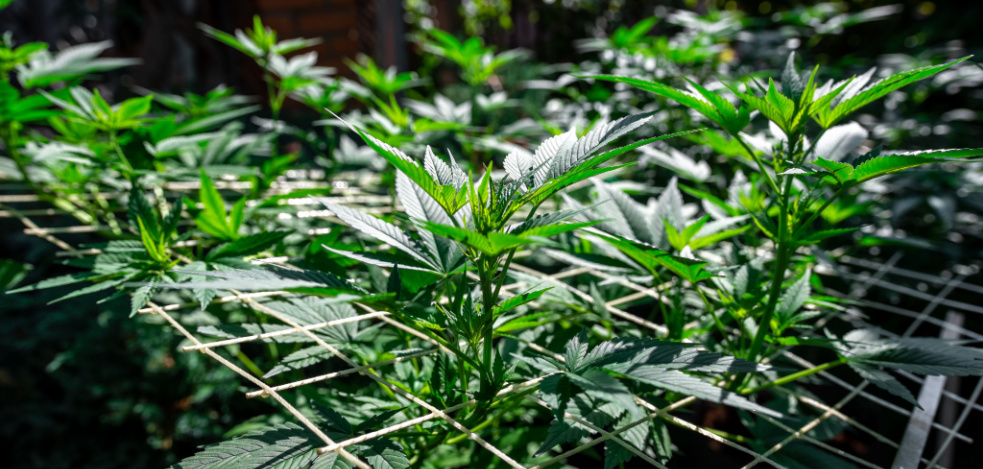
Considered a low-stress technique for growing a ton of smaller plants in tight quarters, the Sea of Green method relies on crops maturing, sharing branches and leaves, as they create a canopy effect together. When grown in a larger volume, the canopy effect of the Sea of Green method clarifies how the technique earned its name.

Growing with the Sea of Green method puts a focus on growing outward rather than upward as gardeners seek to improve their plant per sq/ft ratio. This method works to reduce the flowering time of the plant, allowing for many more harvests per year.

Note – When growing with the Sea of Green method, gardeners must grow all the same strain. Indica-dominant cannabis crops tend to thrive under the SOG method as they are naturally sturdier, shorter, and possessed of bushier foliage.

Example SOG Set Up

You will not need any specialized equipment to run the Sea of Green gardening technique in your home or garden. What you will need are at least four plants to start your Sea of Green, understanding that there is no upper limit. 

  1. Acquire Plants –  You will need at least four plants to properly run the Sea of Green growing technique. So long as you do not exceed one plant per sq/ft, there are no true upper limitations to the number of plants you can cultivate with this method.
  2. Evenly Place Your Lighting – If you are growing indoors, you need to accommodate the lighting needs of your entire canopy. Properly and evenly distribute lighting overtop the canopy of your Sea of Green. By properly placing your lights, you can ensure that the stems and branches will grow directly upward.
  3. Hydroponics or Soil? – For hydroponic growers, the Sea of Green method performs best when paired with a flood-and-drain feeding system. In this system, also known as an ebb-and-flow set-up, nutrients are fed to the plants through a reservoir, timed with a clock, and powered by a watering pump.
  4. Stay Mindful of the Elements – Whether you are growing indoors or outdoors, you must pay close attention to the heat and humidity of your plants. Excess humidity and high levels of heat can cause your crop to struggle. Pathogens and pests are particularly problematic in humid and hot areas. Indoor growers should add enough ventilation to properly account for these issues.

Will the Sea of Green Increase Yield?

The original intention behind the Sea of Green growing technique was to keep crops as small as possible, thus improving the number of plants per square foot (with a maximum of 1 plant per sq/ft). If the ratio of plants exceeds one per sq/ft, it would lead the plants to fight for ventilation and the whole crop would struggle.

Thanks to the quick turnaround times of the Sea of Green method, many growers find that they will accrue more ounces per sq/ft with a larger overall yield. Rapid snug development and reduced vegetative time are the leading factors for this improved yield.

Other Benefits of the SOG Method

  • Shorter Flowering Time
  • Reduced Risk of Pests, Disease, and Handling Error
  • Less Intensive Trimming Process
  • Fewer Underdeveloped ‘Popcorn’ Buds

Best Strains for the SOG Method?

The Sea of Green growing method is ideal for a host of strains from seed banks throughout the world. Experienced growers will know that the best SOG results come from plants that have been cloned or taken as a cutting. 

With that being said, some Indica-dominant strains that are routinely heralded for their success as SOG plants include: 

  • White Widow
  • Super Skunk
  • Hindu Kush
  • Northern Lights

Tips and Techniques to Succeed With the Sea of Green

While the Sea of Green growing method works to make the process more simple than ever, some certain tips and techniques can alleviate hardship along the way.

Whether you are exploring the SOG for the first time or simply looking to make your next crop your best crop, consider these tips and techniques before you break ground again.

  • Quality Genetics – Genetic quality is the key to success and this is doubly important with the Sea of Green technique. Prioritize Indica-dominant plants that grow better in smaller spaces.
  • Avoid Stretchy Strains – Plants with extended flowering stages will often stretch extensively, something not great for the SOG method. Opt for plants with traditionally short flowering times.
  • Regulate Your Environment – Evenly spaced lights coupled with proper ventilation will ensure that your plants are thriving. 


What does Thailands legalization of marijuana mean?

If you’ve heard that cannabis is now fully legal in Thailand, you’re sort of right, sort of wrong.

Yes, it’s true that Thailand has become the first Asian country to officially decriminalize the sacred herb and allow residents to grow and sell their own cannabis products, primarily for medical needs. The country previously allowed the sale of medical cannabis in 2018.

This latest move makes it easier and safer for customers seeking health and wellness remedies to legally acquire and possess cannabis, as well as for restaurants to put it in food and drinks without facing any legal risks.

But it’s also true that you are not allowed to light up anywhere or anytime you want: public smoking can lead to a fine of 25,000 Thai baht, about $780 USD, and/or up to three months in jail. Non-medical use is also discouraged.

Extracted products like oil available for sale also can’t contain more than 0.2 percent of THC, the main natural compound that causes temporary physical and mental changes when smoked or eaten. So, this means people seeking legendary high-potency Thai sticks and other ganja products, at least legally, may be disappointed.

Government officials have made it clear that the country’s reversal of previous strict cannabis laws is more for health and commerce reasons, and they require that anyone who wants to grow and sell their own products legally – up to six plants per person — must register for a permit.

Patients are also encouraged to go to licensed clinics to acquire their cannabis.

Public Health Minister Anutin Charnvirakul told NPR that the government is initially treading lightly with these new policies, and he prefers that citizens first demonstrate better awareness and cooperation in this new legal marketplace, rather than the country trying to create a regimented, strict approach and levying penalties for those who abuse these new privileges.  

Charnvirakul also emphasizes that, if the country performs well with these new changes, it could mean more reforms and permissiveness toward cannabis in the future, such as more laws allowing recreational use. If there are abuses, he said the Public Health Ministry can easily bring back earlier restrictions.


Historical Uses

The announcement of decriminalization in June included the info that more than 1 million cannabis seedlings were going to be given away nationwide to residents interested in exploring the benefits of growing the plant for health or financial reasons.

This news was accompanied by the word that more than 4,000 people now in jail for cannabis crimes will be released, and any money and cannabis that was confiscated from them will be returned.

All of this reverses a general push against the plant that has been in place to some degree for nearly a century.

The country has good natural growing conditions for the plant, and many believe it was brought from India long ago, where it thrived in the tropical climate. It was used ritually, in food, and for hemp products.

But as part of the international prohibitions led by the U.S. in the 1920s and 1930s, it joined many other countries from around the world in making the exporting of cannabis illegal to countries where the plant is illegal. However, an underground marketplace never quite went away.

Since then, Thailand has generally followed the U.S policies and trade agreements in terms of cracking down on cannabis production and sales.

However, unlike the U.S., which continues to classify cannabis in the same highly dangerous category as heroin and LSD (no accepted medical use and high potential for abuse), Thailand puts the plant in the ‘least serious’ category that includes natural kratom leaves and psychedelic mushrooms.  

Still, the U.S. Drug Enforcement Agency maintains active offices in Bangkok and major cities, which it has maintained since the Vietnam War.

For many soldiers in this war, Thailand was a popular place to take leave, and strong cannabis was considered of the country’s luxurious local offerings. Soldiers returning from the war also brought back seeds and plants from some of the stronger Asian strains, which accelerated the country’s underground cannabis activity.

Interestingly, in 2002, the country’s Prime Minister even suggested legalizing cannabis and other less dangerous narcotics, so more resources could be put into combatting more serious threats like methamphetamine and heroin. His proposal failed but still emphasized that cannabis, while acknowledged as illegal, rarely received the full attention of local law enforcement.

In fact, whatever laws say, it remains popular in folk medicine and in recipes. Some restaurants have learned to use parts of the plants that aren’t psychoactive, and hemp remains a useful textile.


Thailand Today  

With the approval of decriminalization, Thailand joins Canada, Mexico, Georgia and four other countries that permit cannabis to some degree at a national level, although Thai officials stress that medical cannabis must be a prime focus rather than full adult-use/recreational.

Officials hope that by making cannabis more accessible for health-focused consumers, it could lead to an increase in tourism as well as stimulate local agricultural businesses to get involved in a new potentially lucrative commodity.

They envision more visitors to the country – and even Thai tourists — seeking local strains, as well as food fans visiting restaurants and cafes to sample infused cannabis in local cuisine, especially curry dishes.

At the same time, releasing those serving time and not making further arrests could reduce the populations of already-overcrowded prisons.

Since other countries in the region still have strict cannabis laws in place, Thailand’s openness could be a draw for those seeking cannabis – no fear of getting caught, provided you don’t partake in public, and don’t try to take it back home if you live in a country or state where strict laws are in place.  


Top 10 Strongest Marijuana Strains

What is Lorem Ipsum?

Lorem Ipsum is simply dummy text of the printing and typesetting industry. Lorem Ipsum has been the industry’s standard dummy text ever since the 1500s, when an unknown printer took a galley of type and scrambled it to make a type specimen book. It has survived not only five centuries, but also the leap into electronic typesetting, remaining essentially unchanged. It was popularised in the 1960s with the release of Letraset sheets containing Lorem Ipsum passages, and more recently with desktop publishing software like Aldus PageMaker including versions of Lorem Ipsum.

Why do we use it?

It is a long established fact that a reader will be distracted by the readable content of a page when looking at its layout. The point of using Lorem Ipsum is that it has a more-or-less normal distribution of letters, as opposed to using ‘Content here, content here’, making it look like readable English. Many desktop publishing packages and web page editors now use Lorem Ipsum as their default model text, and a search for ‘lorem ipsum’ will uncover many web sites still in their infancy. Various versions have evolved over the years, sometimes by accident, sometimes on purpose (injected humour and the like).


Where does it come from?

Contrary to popular belief, Lorem Ipsum is not simply random text. It has roots in a piece of classical Latin literature from 45 BC, making it over 2000 years old. Richard McClintock, a Latin professor at Hampden-Sydney College in Virginia, looked up one of the more obscure Latin words, consectetur, from a Lorem Ipsum passage, and going through the cites of the word in classical literature, discovered the undoubtable source. Lorem Ipsum comes from sections 1.10.32 and 1.10.33 of “de Finibus Bonorum et Malorum” (The Extremes of Good and Evil) by Cicero, written in 45 BC. This book is a treatise on the theory of ethics, very popular during the Renaissance. The first line of Lorem Ipsum, “Lorem ipsum dolor sit amet..”, comes from a line in section 1.10.32.

The standard chunk of Lorem Ipsum used since the 1500s is reproduced below for those interested. Sections 1.10.32 and 1.10.33 from “de Finibus Bonorum et Malorum” by Cicero are also reproduced in their exact original form, accompanied by English versions from the 1914 translation by H. Rackham.

Where can I get some?

There are many variations of passages of Lorem Ipsum available, but the majority have suffered alteration in some form, by injected humour, or randomised words which don’t look even slightly believable. If you are going to use a passage of Lorem Ipsum, you need to be sure there isn’t anything embarrassing hidden in the middle of text. All the Lorem Ipsum generators on the Internet tend to repeat predefined chunks as necessary, making this the first true generator on the Internet. It uses a dictionary of over 200 Latin words, combined with a handful of model sentence structures, to generate Lorem Ipsum which looks reasonable. The generated Lorem Ipsum is therefore always free from repetition, injected humour, or non-characteristic words etc.

Beginner’s Guide: Purchasing Marijuana Seeds

What is Lorem Ipsum?

Lorem Ipsum is simply dummy text of the printing and typesetting industry. Lorem Ipsum has been the industry’s standard dummy text ever since the 1500s, when an unknown printer took a galley of type and scrambled it to make a type specimen book. It has survived not only five centuries, but also the leap into electronic typesetting, remaining essentially unchanged. It was popularised in the 1960s with the release of Letraset sheets containing Lorem Ipsum passages, and more recently with desktop publishing software like Aldus PageMaker including versions of Lorem Ipsum.

Why do we use it?

It is a long established fact that a reader will be distracted by the readable content of a page when looking at its layout. The point of using Lorem Ipsum is that it has a more-or-less normal distribution of letters, as opposed to using ‘Content here, content here’, making it look like readable English. Many desktop publishing packages and web page editors now use Lorem Ipsum as their default model text, and a search for ‘lorem ipsum’ will uncover many web sites still in their infancy. Various versions have evolved over the years, sometimes by accident, sometimes on purpose (injected humour and the like).


Where does it come from?

Contrary to popular belief, Lorem Ipsum is not simply random text. It has roots in a piece of classical Latin literature from 45 BC, making it over 2000 years old. Richard McClintock, a Latin professor at Hampden-Sydney College in Virginia, looked up one of the more obscure Latin words, consectetur, from a Lorem Ipsum passage, and going through the cites of the word in classical literature, discovered the undoubtable source. Lorem Ipsum comes from sections 1.10.32 and 1.10.33 of “de Finibus Bonorum et Malorum” (The Extremes of Good and Evil) by Cicero, written in 45 BC. This book is a treatise on the theory of ethics, very popular during the Renaissance. The first line of Lorem Ipsum, “Lorem ipsum dolor sit amet..”, comes from a line in section 1.10.32.

The standard chunk of Lorem Ipsum used since the 1500s is reproduced below for those interested. Sections 1.10.32 and 1.10.33 from “de Finibus Bonorum et Malorum” by Cicero are also reproduced in their exact original form, accompanied by English versions from the 1914 translation by H. Rackham.

Where can I get some?

There are many variations of passages of Lorem Ipsum available, but the majority have suffered alteration in some form, by injected humour, or randomised words which don’t look even slightly believable. If you are going to use a passage of Lorem Ipsum, you need to be sure there isn’t anything embarrassing hidden in the middle of text. All the Lorem Ipsum generators on the Internet tend to repeat predefined chunks as necessary, making this the first true generator on the Internet. It uses a dictionary of over 200 Latin words, combined with a handful of model sentence structures, to generate Lorem Ipsum which looks reasonable. The generated Lorem Ipsum is therefore always free from repetition, injected humour, or non-characteristic words etc.

Statement from Rocketseeds

What is Lorem Ipsum?

Lorem Ipsum is simply dummy text of the printing and typesetting industry. Lorem Ipsum has been the industry’s standard dummy text ever since the 1500s, when an unknown printer took a galley of type and scrambled it to make a type specimen book. It has survived not only five centuries, but also the leap into electronic typesetting, remaining essentially unchanged. It was popularised in the 1960s with the release of Letraset sheets containing Lorem Ipsum passages, and more recently with desktop publishing software like Aldus PageMaker including versions of Lorem Ipsum.

Why do we use it?

It is a long established fact that a reader will be distracted by the readable content of a page when looking at its layout. The point of using Lorem Ipsum is that it has a more-or-less normal distribution of letters, as opposed to using ‘Content here, content here’, making it look like readable English. Many desktop publishing packages and web page editors now use Lorem Ipsum as their default model text, and a search for ‘lorem ipsum’ will uncover many web sites still in their infancy. Various versions have evolved over the years, sometimes by accident, sometimes on purpose (injected humour and the like).


Where does it come from?

Contrary to popular belief, Lorem Ipsum is not simply random text. It has roots in a piece of classical Latin literature from 45 BC, making it over 2000 years old. Richard McClintock, a Latin professor at Hampden-Sydney College in Virginia, looked up one of the more obscure Latin words, consectetur, from a Lorem Ipsum passage, and going through the cites of the word in classical literature, discovered the undoubtable source. Lorem Ipsum comes from sections 1.10.32 and 1.10.33 of “de Finibus Bonorum et Malorum” (The Extremes of Good and Evil) by Cicero, written in 45 BC. This book is a treatise on the theory of ethics, very popular during the Renaissance. The first line of Lorem Ipsum, “Lorem ipsum dolor sit amet..”, comes from a line in section 1.10.32.

The standard chunk of Lorem Ipsum used since the 1500s is reproduced below for those interested. Sections 1.10.32 and 1.10.33 from “de Finibus Bonorum et Malorum” by Cicero are also reproduced in their exact original form, accompanied by English versions from the 1914 translation by H. Rackham.

Where can I get some?

There are many variations of passages of Lorem Ipsum available, but the majority have suffered alteration in some form, by injected humour, or randomised words which don’t look even slightly believable. If you are going to use a passage of Lorem Ipsum, you need to be sure there isn’t anything embarrassing hidden in the middle of text. All the Lorem Ipsum generators on the Internet tend to repeat predefined chunks as necessary, making this the first true generator on the Internet. It uses a dictionary of over 200 Latin words, combined with a handful of model sentence structures, to generate Lorem Ipsum which looks reasonable. The generated Lorem Ipsum is therefore always free from repetition, injected humour, or non-characteristic words etc.

How Many Seeds Should You Buy?

When we enter the first couple of months of the new year, it is the perfect time to start planning our cannabis garden. With the outdoor growing season seemingly always just around the corner, generally running from March through November, it is never a bad idea to stock up on cannabis seeds in preparation. The question remains, how many cannabis seeds should you buy so that you are always prepared for your new crop? 

Today, we are going to explore the world of cannabis seeds to better understand how they work, which ones work best for you, and how many you should buy for a successful harvest down the line.

Are Marijuana Seeds Legal to Purchase?

Cannabis seeds are considered a cannabis product just the same as any flower, edible, or concentrate you were to purchase from a dispensary. The legality of marijuana seeds will vary greatly from one state to the next, depending on the local legislation that has been passed.

Individuals living in Adult-Use Legalization states can buy, produce, and trade their seeds within their state – but they cannot cross state lines. In states where cannabis has been legalized only for medical use, it is only these patients who can purchase seeds.

Take a moment to browse the internet and you’ll likely run into seed banks that are operating out of the United States. These seed banks offer their wares for souvenir purposes only. These seeds are illegal to transport into the United States and are seized by Customs upon arrival.

The path to the legal acquisition of marijuana seeds is relatively clear: a reputable supplier based within your own legalized state.

How Many Seeds Do I Need For A Successful Harvest?

In Mother Nature, cannabis will freely pollinate and reproduce by sending forth countless seeds. In a controlled environment, say your cannabis garden, you can’t depend on this type of method. 

Typically, a single regular marijuana seed can result in a plant. That plant will have a 50/50 chance of turning into a female plant that bears the THC-laden buds that we are looking for during harvest. 

Some growers like to take advantage of advancements in the cultivation field by opting for feminized or autoflowering seeds. These specialized marijuana seeds can help you enjoy a successful harvest by limiting your exposure to male plants while focusing on a timely grow. 

Let’s explore the different factors that may impact your seed per plant ratio as you begin to purchase your marijuana seeds.

Factors That Impact Your Seed Per Plant Ratio.

Germination rates are the be-all and end-all of cannabis cultivation. Unless you are working with clones, learning to foster seedling growth can be an integral skill in your repertoire. Before you purchase your seeds, let’s look at the different types so we can better understand their impact on germination.

Different Types of Seeds

Regular Seeds

Regular cannabis seeds are by far the most affordable option in the cannabis marketplace. Regular seeds offer you a 50/50 chance of yielding a female plant. To succeed in utilizing these seeds, growers must carefully take note of their plant’s sex throughout the entirety of the process.

Regular seeds have roughly a 93% germination rate, but with a question mark regarding the sex of the plant, this number can quickly begin to drop. If you are growing through the use of regular seeds, you will want to order extra to overcome any male plants or germination failures.

Feminized Seeds

One way to get around potential failures during germination is by opting for feminized seeds. Feminized seeds have been carefully bred to produce only the revered female cannabis plant. While ostensibly more expensive than the regular and autoflowering seed options on our list, they offer the best bang for their buck – promising a female plant.

Feminized seeds allow growers to focus entirely on the needs of their plant, rather than wasting time focusing on its sex. Feminized seeds are not without their pitfalls as there is no absolute germination guarantee. Pay attention to the sex of your plants and eliminate any males that potentially pop up.  

Autoflower Seeds

Whether you are an expert grower or a newcomer to the hobby, opting for autoflowering seeds may be a great choice to encourage better harvests. Autoflowering seeds don’t change the germination process but they do impact the growth cycle of the entire plant. 

Autoflower seeds are ideal because they are bred to automatically switch to their flowering cycle regardless of your lighting or their location in your garden. When growing traditional photoperiod seeds, growers have to manually adjust their lighting and feeding schedule to account for transitioning.

Autoflower seeds flower based on their age, which leaves less work for the grower.

Germination Success Rate

Once you’ve decided which cannabis seeds will work best for your needs, you are ready to enter the germination stage. Germination is not a fool-proof process and can be a little difficult at first. As germination is notoriously volatile, you’ll want to buy more seeds than you plan on planting.

So, How Many Marijuana Seeds Should You Buy?

While cultivating cannabis is not an easy hobby, advancements in the field have made it much more approachable than it was in times past. Access to autoflowering and feminized seeds have made it easier than ever for individuals to curate large harvests of healthy female plants from the comforts of home.

To ensure your growing season is a successful one, you should opt to buy and plant 25% more seeds than you plan on germinating. You can save time and money by opting for feminized seeds as they will ensure that there is no time lost on male plants.


How Does The DEA Ruling Affect Medical Cannabis Grows?

Have you heard about the latest DEA ruling? Are you worried about its impact on growing cannabis? Are you confused about the ruling? Don’t worry—you’re not alone. In this article, we will help you understand the new DEA ruling and how it affects you.

Firstly, cannabis is federally prohibited; this isn’t changing right now.

However, here’s the good news: The Drug Enforcement Administration (DEA) has admitted that cannabis plant seeds are legal and impossible to control—regardless of how much THC might end up in the buds if growers grow these plants.

This declaration from the DEA is significant. Before this, society determined a marijuana product’s legality by whether the grower sourced it from hemp or marijuana. However, the new guidance ends this; as a result, society can determine the lawfulness of tissue culture, other genetic material, and cannabis seeds purely on delta-9 THC concentration.

DEA Guidance on Marijuana Seeds

The DEA recently reviewed the federal statute in response to an inquiry from attorney Shane Pennington over marijuana seed’s legality, tissue culture, and “other genetic material” that doesn’t contain over 0.3% THC.

The DEA confirmed that while it used to be the case that marijuana seeds were controlled, that’s no longer the case due to the federal legalization of hemp.

The 2018 Farm Bill excluded hemp from the Controlled Substances Act’s (CSA) definition of marijuana. Therefore, all aspects of the plant Cannabis sativa L. are not controlled if they don’t surpass 0.3% THC.

Terrence L. Boos, chief of the DEA’s Drug & Chemical Evaluation Section, wrote: “Accordingly, marijuana seed that has a delta-9-tetrahydrocannabinol concentration of not more than 0.3 percent on a dry weight basis meets the definition of ‘hemp’ and thus is not controlled under the CSA.”

He added: “Conversely, marijuana seed having a delta-9 tetrahydrocannabinol concentration more than 0.3 percent on a dry weight basis is controlled in schedule I under the CSA as marijuana.”

In layman’s terms, because marijuana and hemp contain nominal THC levels that normally wouldn’t exceed the legal threshold, the DEA has noted that people can have cannabis seeds regardless of how much THC the plant produces.

However, it remains illegal to use any cannabis seeds with the intent of growing still-prohibited cannabis. What’s more, the DEA’s guidance doesn’t address whether the U.S. legal system would prosecute people if their seeds were to exceed the 0.3% THC threshold.

Other Guidance From the DEA

The DEA letter also suggests that other materials that growers extract from the plant—such as tissue culture and any other genetic material that has a delta-9-tetrahydrocannabinol concentration of not more than 0.3 percent—match the definition of hemp. As a result, the CSA doesn’t control them.

However, always remember that despite hemp and marijuana seeds containing THC levels that don’t exceed 0.3%, that doesn’t mean they will always fall below the 0.3% threshold. Despite the cannabis laws in your state, remember that it remains federally illegal to grow cannabis seeds with the intent of growing marijuana.

In addition, remember that the DEA’s letter is just guidance. It doesn’t have the full effect and force of the law or official DEA regulation.

What Has the Cannabis Industry Said?

In an edition of his drugs newsletter, Sean Pennington said: “In my view, the letter is significant because we continue to see the confusion over the source rule—the argument that the legal status of a cannabis product hinges on whether it is ‘sourced’ from marijuana or hemp—influencing legislative proposals even at the federal level.”

“Now that we know that the legality of the ultimate ‘source’ of both hemp and marijuana plants (their seeds) hinges on delta-9 THC concentration alone, reliance on the source rule is much harder to defend.”

“I’m hopeful this will clear up a lot of confusion in this area of law,” he added.

What Have Lawmakers Said?

Due to the risk posed by the DEA’s interpretation, the Hemp Industries Association and RE Botanicals, Inc., have challenged the DEA’s authority. Converting raw hemp with less than 0.3% delta-9 THC into consumer products with less than 0.3% delta-9 THC presents a risk. Lawmakers have taken notice.

Nine congressmen sent a letter to the DEA after they announced the interim final rule suggesting they revise the rule. The authors wrote: “Since the Farm Bill legalized hemp along with hemp derivatives, extracts, and cannabinoids, it logically follows that the only viable methods for processing hemp into those derivatives, extracts, and cannabinoids would also be legal.”

In 2022, Rep. Chellie Pingree of Maine started the Hemp Advancement Act of 2022; this clarifies that hemp extracts made during the hemp production process that surpass the 0.3% THC threshold will still be legally considered hemp and therefore banned from the CSA Schedule I listings and DEA control.

So, if the Hemp Industries Association and RE Botanicals fail in their lawsuits, Congress may take action to safeguard hemp growers from DEA enforcement anyway, which is fantastic news for hemp producers.

The Penalties for Growing Marijuana Illegally

If you live in a state that doesn’t allow the cultivation of cannabis, you may face criminal charges. Even with a medical marijuana card, your state’s regulations may limit you from home-growing weed.

Penalties for growing weed at home may include jail time, fines, and even property seizure. However, the penalties for growing cannabis at home depend on several factors, such as:

  • Number of cannabis plants
  • Evidence of producing pot for sale
  • Other drugs manufactured or grown
  • Prior criminal record

Ensure you check the laws within your state before growing cannabis to avoid any issues. The following states allow citizens to grow limited marijuana for medical usage:

  • Alaska
  • Arizona
  • California
  • Colorado
  • Hawaii
  • Illinois
  • Maine
  • Massachusetts
  • Michigan
  • Missouri
  • Montana
  • Nevada
  • New Hampshire
  • New Mexico
  • Oklahoma
  • Oregon
  • Rhode Island
  • Vermont
  • Washington
  • Washington, D.C.

In Summary

The DEA’s ruling doesn’t change the medical standing of cannabis. However, it does allow cannabis seeds to be considered hemp or medical rather than recreational. Overall, it’s good news for the cannabis industry and growers.

Light Schedules: How To Use Them And Why They Are Important

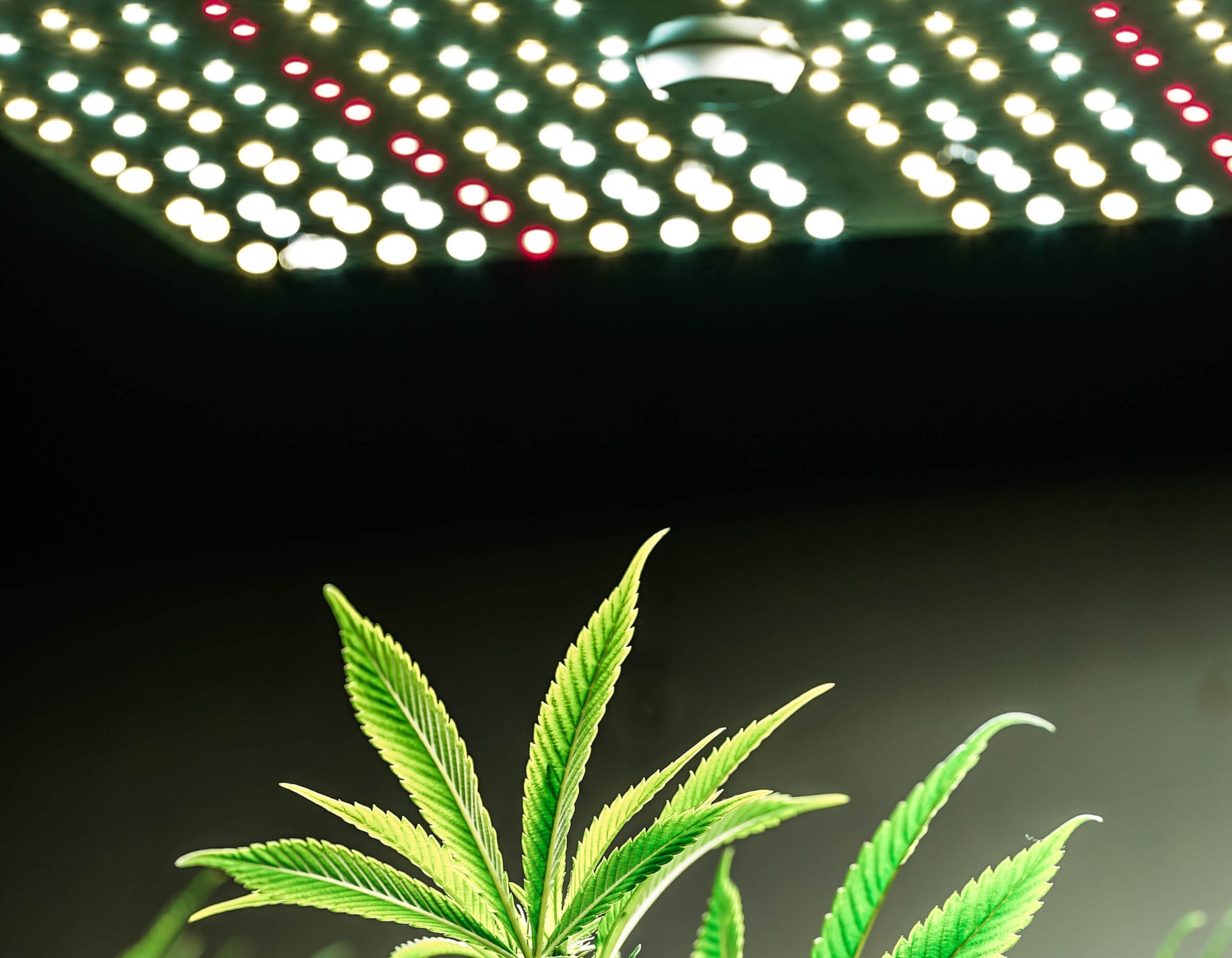
When cultivating cannabis, few things are as crucial as proper light schedules. As a photoperiod plant, the amount of light your plant receives will dictate when it starts flowering and how heavy the harvest will be. By giving your cannabis plant 12 hours of darkness (uninterrupted) per day, they will begin to flower.

To maximize your ability to find success cultivating cannabis, we need to understand how to maximize the effectiveness of our lighting schedule though.

Today, we will take a deep dive into light schedules for cannabis seeds and the changes they must undergo for indoor and outdoor operations.

What Are Light Schedules?

Light schedules involve the cycle of darkness and light used to bolster the growth of your plant. As cannabis plants require intense levels of light with changing needs throughout their growth, cultivators must be ready to change their system to meet the needs of their plants.

We can see how scheduled lighting can change based on the stage of your plant’s growth.

Stage 1: Light Schedule for Cannabis Seedlings

Every great cannabis plant began as a seedling. After you’ve acquired your seeds and have properly germinated them, you are ready to introduce a lighting schedule. At this stage of your plant’s growth, it is considered a seedling. Seedlings may have small roots, but they are not yet ready to be transplanted.

To maximize the lighting schedule of your seedlings, give the plant plenty of energy so that it can develop its root system. Developing a functioning root system is an energy-intensive task and thus requires roughly 18 hours of light per day with 6 hours of darkness to follow.

Growers have been experimenting with lighting schedules in the seedling phase since the first cannabis seeds were cultivated. Some growers opt for 20 hours of light with 4 hours of darkness to pump up the efficiency of their operation while still giving their plants time to catch their breath.

Here’s a warning though, seedlings do not require bright lights to prosper or grow well. Lights that overpower your seedlings can end up harming them, reducing their ability to grow healthily. Use weaker bulbs or dimmer lights to protect your plants from heat and potential burns.

Unless you are working with autoflowering seeds, opt for an 18/6 or 20/4 light schedule.

Stage 2: Entering the Vegetative Stage

As one of the most important times in a plant’s life cycle, the vegetative stage must be carefully monitored to maximize later success. This stage is when the plant grows both taller and wider, developing stems, leaves, and the other biological matter necessary for its bud sites to flourish.

Whether you’re working with outdoor or indoor plants, you must provide them with at least 13 hours of light per day. Growers can potentially keep their plants in the vegetative state forever so long as they maintain short nights with a proper light schedule.

To maximize the growth of your plant while it is in this state, provide up to 24 hours of light per day. Some growers will opt for an 18/6 schedule to provide relief at night for their plants while still encouraging quick growth during those daylight hours.

For outdoor growers, you will see your plants transition from the vegetative stage late into the spring or early into summer, though every strain is different.

Can I Avoid Light Schedules?

For novice to intermediate growers, avoiding lighting schedules can be as simple as opting for autoflowering seeds. Autoflowering seeds are strains that will flower automatically after roughly three months, no matter what lighting is provided by their grower. More simple and easier to implement than traditional outdoor cannabis seeds, autoflowering strains are a great way to get your first plants started.

With this being said though it’s important to pay attention to your seedbank’s instructions to make sure that you can find the right autoflowering strains for your operation.

Stage 3: Entering the Flowering Stage

With the vegetative state behind us, it is time to look ahead to the third and final phase of these plants’ life cycles. This stage occurs naturally for outdoor growers when their plants get 12 hours of sunlight per day. Outdoor flowering stages can last between 8 and 12 weeks, depending on the strain, the growing environment, and the health of the plant.

For indoor growers, a lighting schedule of 12 hours on and 12 hours off will help to initiate the flowering cycle. Once the cultivator has changed their lights over to this 12/12 schedule, they will have roughly six weeks to five months of growing time before their plants are ready for harvest.

Note For ALL Growers: Avoid any light pollution at night. Make sure that the plants are not exposed to light during the night or dark periods, even from spotlights or streetlights. Light pollution can confuse your cannabis plants, thus preventing them from flowering properly.

Working With Autoflowering Strains

The world of autoflowering strains has fundamentally changed how many folks approach cannabis cultivation. Autoflowering cannabis plants are plants that have been crossbred with Cannabis Ruderalis. The resulting plant is a cannabis plant that flowers based on time rather than the light/dark schedule put in place by the grower.

Autoflowers traditionally have a short vegetative phase without the need to switch to a 12/12 schedule during flowering. Some growers will grow autoflowering strains with an 18/6 light cycle throughout the entire duration of their plant’s growth.

Light schedule suggestions for autoflowering cannabis include:

  • 12 / 12 –  Having a lighter energy load, a 12/12 schedule should lead to lower light intake, lower yields, and a less productive plant.
  • 18 / 6 – With 18 hours of daylight and 6 hours of rest, autoflowering plants tend to prosper the most under this schedule.
  • 20 / 4 – This is an experimental lighting schedule that is said to maximize the overall productivity of the plant.

Properly lighting your cannabis plant is one of the most important steps in their growth. Seedlings don’t need a ton of light, vegging plants demand a lot of energy, and flowering plants must have at least 12 hours of darkness per night. With this all being said though, you should always be ready to experiment with your scheduling as genetics may cause variation between strains that might impact your overall results.